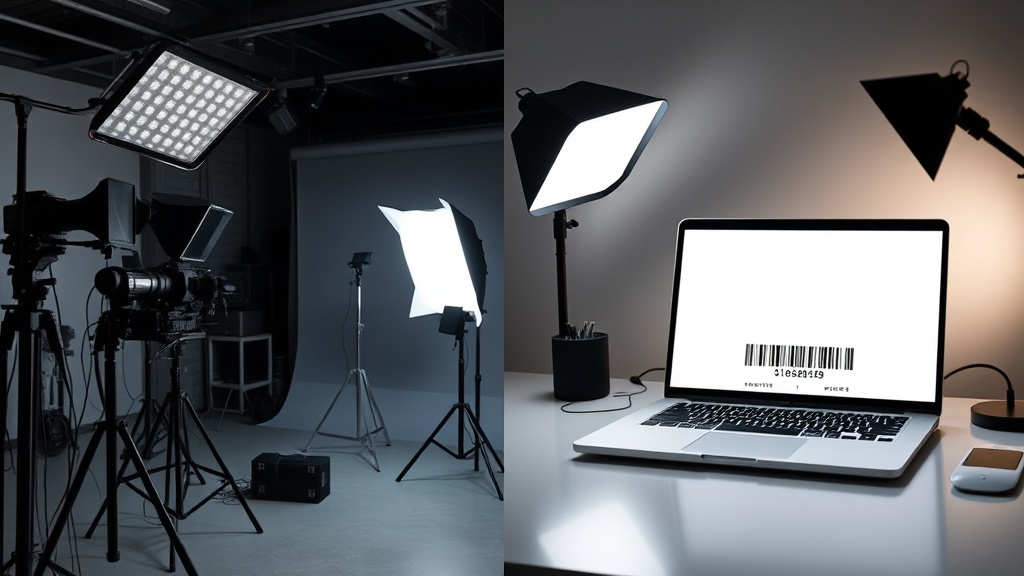
Every Amazon FBA seller eventually faces the same spreadsheet moment: multiply your SKU count by your photographer's per-SKU rate, watch the number climb past $10,000, and wonder if there's another way.
There is. But the answer isn't "always use automation" — it's "use the right tool for each product." This post gives you an honest framework for making that call, including scenarios where professional photography is absolutely the right investment.
What You'll Learn
- The real cost comparison: traditional photography vs. automated barcode lookup
- When automation wins (and the 5 product categories where it clearly does)
- When to use a photographer (and the 4 scenarios where it's the right call)
- A decision matrix: 5 factors, clear winner per scenario
- The math for a 100-SKU launch — both models side by side
The Two Models
Model A: Traditional Photography ($85–$150/SKU average)
The traditional workflow:
- Contact a photography studio (there are hundreds specializing in Amazon product shots)
- Ship physical samples to the studio ($50–$200 per shipment)
- Brief the photographer on your shot list (white background, lifestyle, infographics)
- Wait 1–2 weeks for the shoot
- Review and request revisions (another week)
- Download images, process for Amazon requirements, upload to Seller Central
Cost breakdown per SKU (mid-market studio, 6 images):
- Studio rate: $85–$150
- Sample shipping: $5–$20/SKU (split across shipment)
- Retouching: $10–$25/SKU
- Coordination time (your time): ~$15/SKU at $50/h
- Total: $115–$210/SKU average
For commoditized categories with volume, many studios offer package rates around $65–$85/SKU with 4 images. Let's call the floor $65.
Model B: Automated Barcode Lookup ($2/SKU)
The automated workflow:
- Collect your product barcodes (EAN/UPC/GTIN) — already in your supplier sheets
- Submit to the SKU Monster API (batch or single)
- Receive 5+ white-background studio images per product
- Download, upload to Seller Central
Cost: $2/SKU. No shipping. No wait. No coordination.
For a 100-SKU catalog: $200 total, delivered in hours.
The 100-SKU Launch: Side-by-Side Math
| Cost Category | Traditional | Automated |
|---|---|---|
| Photography/image retrieval | $8,500 | $200 |
| Sample shipping | $1,500 | $0 |
| Coordination time (15h @ $50/h) | $750 | $0 |
| Reshoots (~10% of SKUs) | $750 | $0 |
| Post-processing (20%) | $2,250 | $0 |
| Total | $13,750 | $200 |
| Time | 4–6 weeks | 24–48 hours |
The gap: $13,550 saved and 4–5 weeks faster. For a seller operating on 30% margins at $30 average sale price, that's the equivalent of 1,500 units of pure margin — before you've made a single sale.
When Automation Wins
The automated model works best for products that already have a commercial photography history. Here are the five scenarios where it clearly wins:
1. Commoditized Consumer Goods
Electronics accessories (cables, chargers, cases), household goods (storage containers, cleaning supplies), beauty basics (commodity moisturizers, vitamins), kitchen items, tools. These products were photographed professionally when they were first distributed to retailers. The images exist.
2. Wholesale Resellers and Distributors
If you're sourcing from a distributor or buying branded goods wholesale, the manufacturer has already invested in professional photography. That photography is indexed by barcode. You're not the first seller — use the existing assets.
3. Large Catalogs (50+ SKUs)
At 50+ SKUs, photography becomes a logistics problem. Coordinating 50 sets of samples, 50 shoots, and 50 approval rounds is a full-time job. At 200 SKUs, it's genuinely infeasible for a small operation. Automation handles 1,000 SKUs as easily as 10.
4. Speed-to-Market Priority
Amazon ranking rewards early listing velocity. A product launched 4 weeks earlier captures 4 weeks of organic ranking signals. If you're launching in a seasonal category, missing your window by 6 weeks because you're waiting on a photographer is a real business impact.
5. Tight-Margin Products
If your product sells at $12 with a 25% margin, you're making $3 per unit. Spending $150 on photography means you need 50 sales to break even on a single SKU's images — before you've covered any other launch cost. At $2/SKU, break-even is one sale.
When to Use a Photographer
Automation isn't the right answer for every product. Here are four scenarios where professional photography is the clear call:
1. Brand-Differentiated Products
If your product looks meaningfully different from the category average — because of design, materials, packaging, or story — that difference needs to be shown. A generic white-background image of a mass-produced competitor's version doesn't represent your product's actual value proposition.
2. Lifestyle-Dependent Categories
Home décor, fashion, outdoor gear, baby products — categories where the context matters as much as the product. A $350 standing desk can't be sold with a white-background stock image. The lifestyle shot showing it in a home office is doing real conversion work.
3. Premium and Luxury Goods
If you're pricing at a premium, your imagery needs to justify it. Buyers comparing a $25 item to an $85 item expect the $85 version to look visibly better. That requires production value a stock barcode lookup won't deliver.
4. New and Unlisted Products
If your product is private label, very recently launched, or genuinely novel, it won't be in any barcode database. There are no pre-existing images to retrieve. Photography is the only path.
The Decision Matrix
| Factor | Use Photographer | Use Automation |
|---|---|---|
| Product is brand-differentiated | ✓ | |
| Product is commoditized (cable, basic tool, etc.) | ✓ | |
| 1–5 SKUs | ✓ | |
| 50+ SKUs | ✓ | |
| Lifestyle imagery is core to conversion | ✓ | |
| Speed-to-market is critical | ✓ | |
| Price point under $15, tight margins | ✓ | |
| Premium or luxury positioning | ✓ | |
| Wholesale/reseller catalog | ✓ | |
| New product, no prior retail history | ✓ |
The honest hybrid: For most FBA businesses with 50+ SKUs, the answer is both. Use automated barcode lookup for 80–90% of your catalog to launch fast and cheap. Invest professional photography budget in your 3–5 hero products that drive the most revenue.
The Real Objection: "Will the Images Be Good Enough?"
This is the right question to ask. The answer depends on where the images came from.
SKU Monster indexes images from the brands' own product photography — the same images used by major retailers, the same images the manufacturer uses on their own website. These are professionally lit, white-background studio images meeting Amazon's technical specifications.
They are not user-submitted photos. Not screenshot captures. Not scraped thumbnails. They're the same images a retailer would use for a product listing.
For commoditized products in mainstream categories, "good enough" isn't the right frame. The images are professionally produced — they just weren't produced by you.
Summary
Traditional Amazon product photography costs $65–$210/SKU with a 4–6 week lead time. Automated barcode-based image retrieval costs $2/SKU and delivers in hours. For a 100-SKU catalog, the cost difference is $13,500+.
The right choice depends on your product. Brand-differentiated, lifestyle-dependent, or premium products justify professional photography. Commoditized products, wholesale catalogs, and large-SKU launches are where automation delivers clear ROI with no quality compromise.
Ready to Try It?
Start on SKU Monster free — enter any commodity product barcode and see the images come back instantly. Use the pricing calculator to see your catalog savings.